No gurus. No gratitude journals. No bullshit.
A brutally honest book about the masks we wear, the emotions we bury, and the small, unremarkable act of becoming more real. Written for the person who keeps it together so perfectly that no one ever thinks to ask if they're okay.
Most books want to improve you. This one just wants you to stop lying to yourself. There is a difference.
You are probably doing fine by every visible measure. You are capable, reliable, the person the room turns to. And underneath that — quietly, behind the eyes — something is slowly getting colder. You perform. You maintain. You deliver. And you have not felt truly seen in longer than you can comfortably admit.
This book does not offer a 10-step transformation or a curated morning routine. It offers something harder and more useful: an honest conversation about the cost of keeping it all together. Written by two brothers who both wore the mask — and finally stopped.
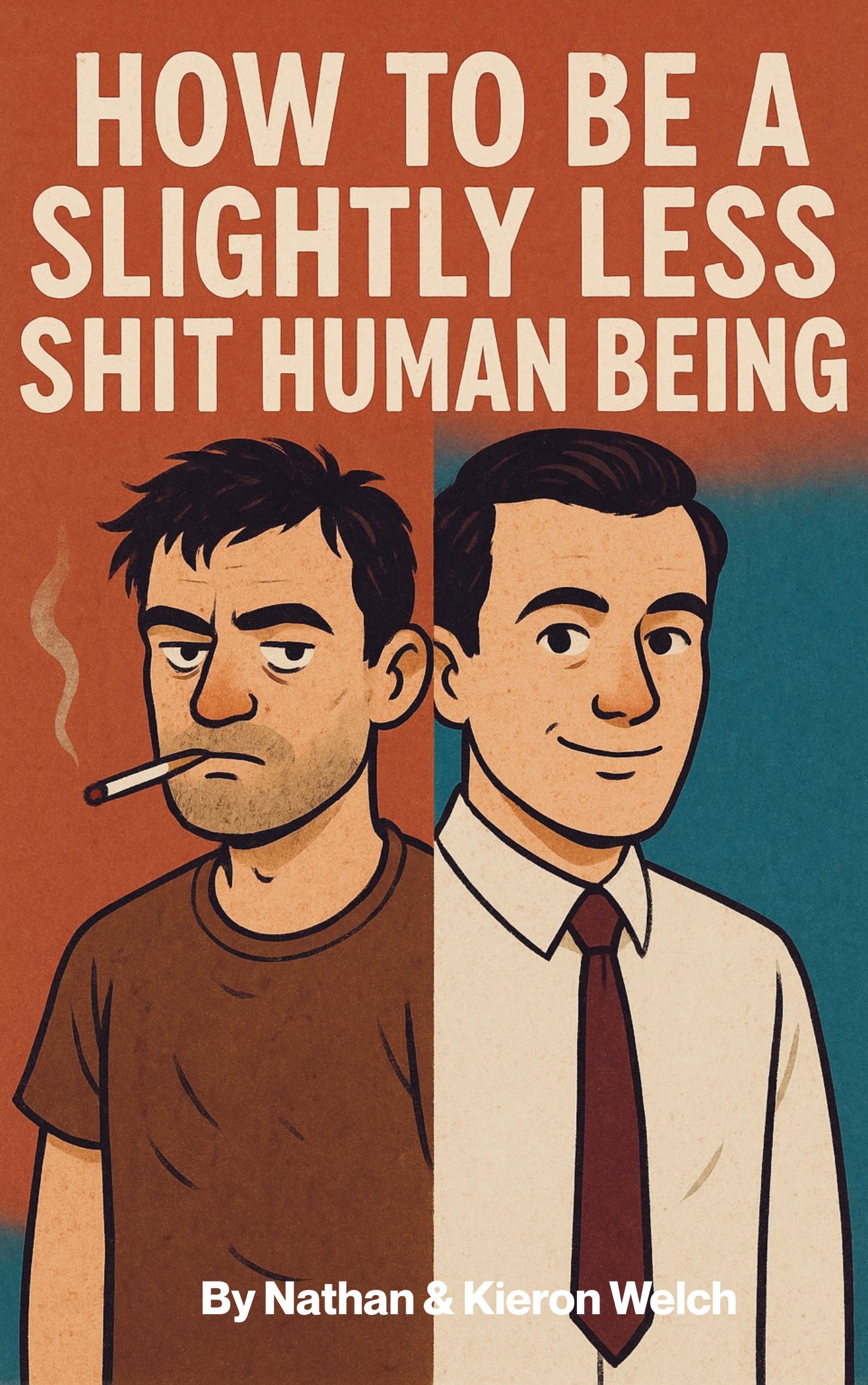
The masks we carry were not chosen — they were earned. Forged from necessity in classrooms, training grounds, offices, and relationships that needed a version of you that would not crack. But the same armour that got you through becomes the thing keeping everything out.
You became the person who handles it. The crisis absorber. The calm in every storm. And you did it so completely that people stopped checking if you were okay — because you trained them not to. The mask worked. That is exactly the problem.
"You become a cardboard cutout of competence."
You weaponised achievement. You called it ambition, structure, purpose. But if we stripped the motivational wallpaper off your Google Calendar, we would find something simpler: you are terrified of stopping. Because stopping means silence. And silence means meeting the truth.
"You're not busy. You're avoidant."
You pushed down the anger — not because it was wrong, but because it was inconvenient. So it leaks now. As sarcasm. As one-syllable answers. As the tension in your jaw you still haven't named. Repressed anger doesn't vanish. It gets repurposed as slow erosion.
"Anger isn't the enemy. It's the flare."
You call it keeping the peace. But if you look closer, it is not peace — it is personal erasure. Every yes when you meant no. Every softened tone. Every apology for having a need. That is not kindness. That is fear in a smart outfit. And you deserve more than a life measured by how little you ask for.
"Every yes that violates your truth is a vote against your own freedom."
That is not a list of flaws to manage. That is a description of a human being who is still fully alive. This book is not a guide to becoming a better version of yourself. It is an invitation to stop editing the one you already are.
No certificate at the end. No finish line. Just the quiet, terrifying, liberating experience of stopping the performance long enough to hear your own voice again.
Every chapter is structured to take you somewhere then make you stay there. Three recurring features run throughout — each designed to do something different to you.
Short, blunt statements that land somewhere between provocation and recognition. No padding. No softening. The kind of sentence that makes you stop and stare at the middle distance for a moment before you can read on.
Questions that do not have comfortable answers. Not there to coach you toward a conclusion — there to surface what you have been carefully not looking at. Use them honestly or not at all.
Each chapter closes with a direction rather than a destination. Not a summary. Not a motivational flourish. Just a clean, honest signal about which way to face next. You take it from there.
The book moves from the mask you built early in life, through the emotions you were never taught to handle, into the slow dismantling of the performance — and eventually, to what is left when you stop pretending. It does not wrap up neatly. That is the point.
No chapter is standalone. Each one strips something away and the next meets you there. Read it straight through, or return to the one that hit hardest. Either way, you will know which one that was.
This book is not for the version of you that attends meetings and manages expectations. It is for the version that sits in the car with the engine off and doesn't quite know why.
You have never been better at surviving. That is precisely the problem. You operate without cracking. You are the one people lean on. And you have not felt genuinely seen in so long that you have stopped noticing the gap. This book was written for that version of you — not the one in your email signature.
Not in a dramatic, crisis way. Just a slow, creeping sense that the life you have built fits the version of you that made other people comfortable. And somewhere in the gap between what you perform and what you actually feel, something important has gone very quiet.
You have read the books. Done the journalling. Maybe downloaded Calm and made it to day four. And nothing quite lands because it is all optimisation — a better system for a life that has a more fundamental problem. This is not that. There are no systems here. Just honesty.
You do not need to hit rock bottom to pick this up. You do not need to be in crisis. You just need to be honest enough to admit that the version of you everyone applauds might not be the one that actually exists.
Available now via Amazon · Published by Dutch Harbour · Written by Nathan & Kieron Welch