Dutch Harbour Publishing  ·  Kieron Welch

Empty
Your Cup

Why unlearning what you know is the most powerful thing you can do in the AI age.

Everything you know has an expiry date. The beliefs, the habits, the expertise that carried you here: some are still fresh, some have been stewing quietly for years without you noticing. Knowing the difference is the whole practice.

New Release
Empty Your Cup by Kieron Welch

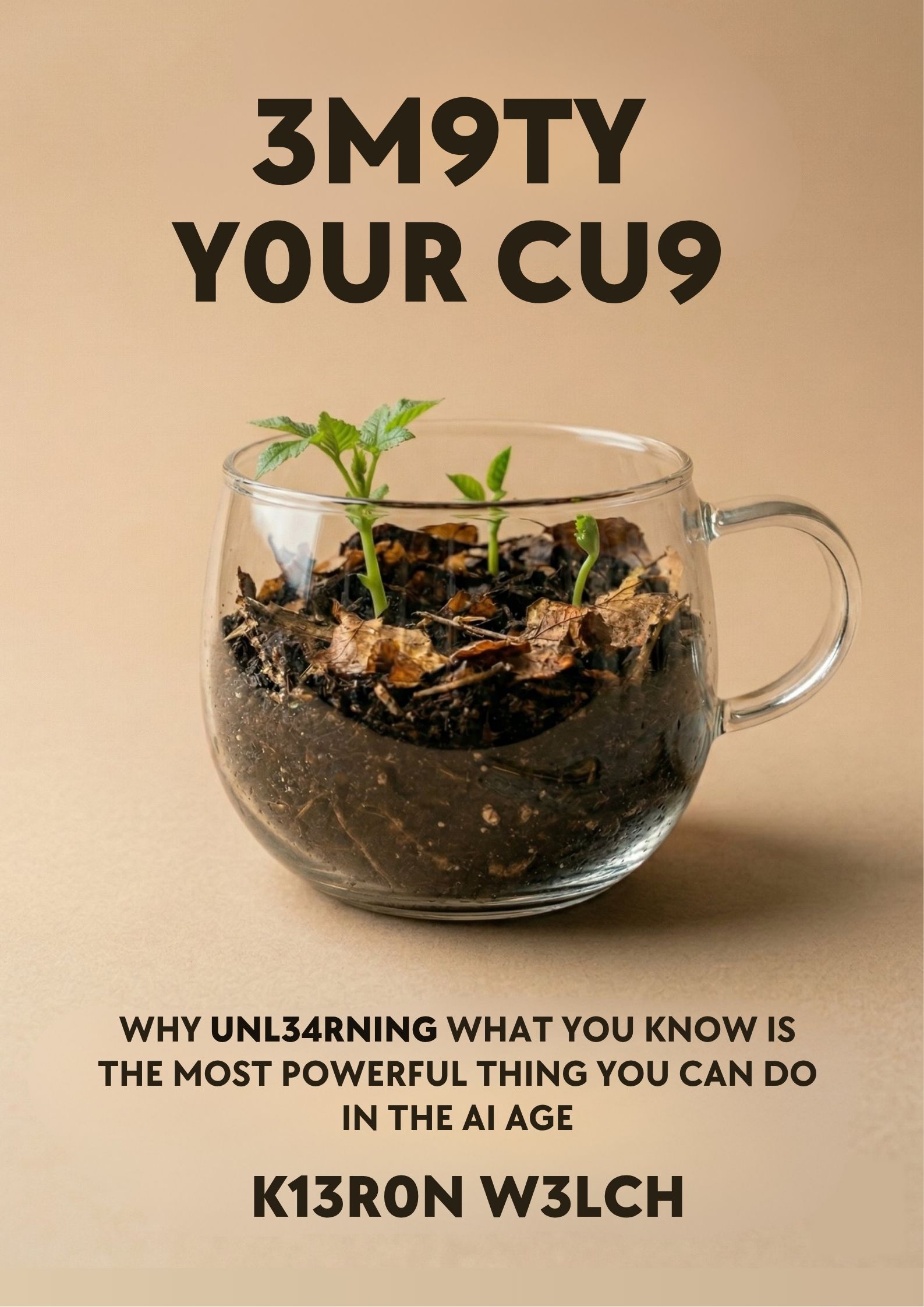
The cipher on the front cover is intentional.
It is the start of your unlearning journey.

What this book is

The rules of expertise just changed. Most people have not noticed.

There is a Zen story that gives this book its name. A scholar visits a master, wanting to demonstrate everything he already knows. The master pours tea. He keeps pouring. The cup overflows. The scholar stares. The master says: how can I show you anything new unless you first empty your cup?

"The cup in the story is not just full of knowledge. It is full of the scholar's sense of himself."

The world used to reward accumulation. The more you knew, the more you were worth. The deeper your expertise, the safer your position. That system has not disappeared. But the world it was built for has changed.

In 2026, Boston Consulting Group analysed 165 million jobs and found that fifty to fifty-five per cent of roles will be reshaped by AI over the next two to three years. Not eliminated. Reshaped. Workers keep their jobs but face fundamentally different expectations for how they work and what they produce.

The ability to unlearn what no longer serves you is now as important as the ability to accumulate what does. This is not a theory. It is a practical, daily, one-per-cent-at-a-time practice built into the fabric of a life that cannot stop while you figure it out.

Get the Book
55%
Roles reshaped by AI
Source: BCG 2026. The challenge is not job loss. It is identity loss. People keep their jobs but face fundamentally different expectations for how they work.
The cold tea problem

Fresh knowledge is exactly what it was meant to be. Leave it too long unexamined and it stews, becomes something you no longer want to drink. You reach for it in the moment you need it most and find it is not quite what you needed it to be.

From the introduction
The 1% principle

The brain does not rewire itself in a single session. It rewires itself across hundreds of small moments, each one adding a fraction to the new path and weakening the old one. One per cent, every day. Sleep does the rest.

The framework at the heart of the book

Synaptic Composting

In nature, a fallen leaf does not disappear. It breaks down. It decomposes into the nutrients that feed the next season's growth. The tree that drops its leaves is not losing something. It is making room for what comes next.

Synaptic Composting is a description of a real process, one already running inside every person who has ever moved from one version of themselves to another. The question is only whether you are working with it consciously, or letting it run untended in the background.

The people who transform most completely are not the ones who delete their past. They are the ones who decompose it. They break the old knowledge, the old identity, the old beliefs, down to their structural elements. They extract what is genuinely theirs: what has real nutritional value, what will still serve them in new conditions. And they let the surface layer fall away. The soil they build from that process is richer than anything they could have constructed from scratch.

01
Stage One

Harvest

The act of identifying what is ready to be composted. Not everything needs composting. Some of what you carry is still fresh, still genuinely nutritious. Harvest is the practice of discernment. You look honestly at what you are carrying and ask: which of these is still serving me, and which has passed its usefulness?

The Harvest is not a dramatic event. It is a quiet, honest inventory: curiosity rather than judgment. You are not condemning what you find. You are dating it.

02
Stage Two

Break Down

This is where the real work begins. Not everything you are releasing deserves to be discarded entirely. Beneath most outdated beliefs is something real and transferable: a principle, an instinct, a hard-won understanding. Break Down is the practice of finding that deeper thing and keeping it, while letting the outer form go.

Break Down does not destroy what you have built. It frees it. It separates what is genuinely yours from what was simply the shape your knowledge took in a particular era.

03
Stage Three

Enrich

The composted material: the extracted nutrients, the structural principles, the transferable wisdom, begins to feed new growth. This is not a passive stage. You actively connect what you have extracted to what you are now building or learning. You do not start from zero. You start from depth.

This is the stage where new growth begins to carry the DNA of what came before. Not as a constraint. As a foundation. As the richest possible starting point for something genuinely new but not rootless.

04
Stage Four

Rest

The stage most people skip, and skipping it is one of the most common reasons transformation does not stick. Composting takes time. You cannot rush it in nature. The same is true in the brain. Sleep, reflection, and unstructured thinking allow your brain to complete the integration work you have started consciously.

You cannot do this work consciously. You can only create the conditions for it. And then you step back and let biology finish the job.

The mechanism

One per cent. Every day. Let sleep do the rest.

The composting process can sound enormous when described at full length. But it does not happen in a single session of honest reflection. It happens in tiny daily increments, each one adding a fractional layer to the new road being built, each one fractionally weakening the old motorway that is no longer being used.

Across eighteen days of micro acts: a question held before sleep, a belief named and examined, a small surrender noticed instead of unconsciously obeyed. Something remarkable happens. Not dramatically. Not with fanfare. You simply wake up one morning and reach for the old belief, and it is not quite where it used to be. The root has loosened. The composting has begun.

1%
Every single day
After one year of one-per-cent daily growth, you are 37 times more capable than when you started. The maths is real. The compounding is the point.
Inside the book

Five parts. Eleven chapters. One honest question.

The book is structured to move you through the full arc. It starts with the world that demands you unlearn, moves through the science and psychology of how that actually works, and lands in the practical daily reality of building an unlearning practice you can sustain.

Every chapter closes with a micro habit. Not an exercise. The actual mechanism of composting. Each one is a single one-per-cent act. Small enough to do today. Powerful enough to compound.

The question under every chapter

What are you holding onto that is costing you more than you know?

Kieron Welch, Empty Your Cup
Introduction
Everything You Know Has an Expiry Date
Part One: Why the Rules Changed
Chapter 1
The Knowledge Trap
Part One
Chapter 2
The AI Acceleration
Part One
Chapter 3
The Adaptability Advantage
Part Two: Science and Psychology
Chapter 4
How Unlearning Rewires the Brain
Part Two
Chapter 5
Synaptic Composting
Part Two
Chapter 6
The Grief of Letting Go
Part Two
Chapter 7
The Five Pillars
Part Three: Continuous Learning
Chapter 8
The Architecture of Continuous Learning
Part Four: Micro Habits
Chapter 9
Fifteen Micro Habits for the Continuous Learner
Part Five: Living It
Chapter 10
Building Your Unlearning Practice
Part Five
Chapter 11
The Continuous Trajectory
Who this book is written for

The real version. The uncertain one.

This book is not for the version of you that shows up to meetings. It is for the version underneath that one.

The experienced professional who feels stuck

You are performing well by every visible measure. Respected. Reliable. The person everyone goes to when something needs doing properly. And quietly, underneath all that, you sense that something in how you operate needs to change. You just cannot name what.

The person the world just moved on without

You have sat in enough rooms to know that the world is asking something different of you now. The questions people ask, the way they frame problems, the things they value: something has shifted. You are not sure when. And you are not yet sure what the answer is.

Anyone facing AI at work and feeling it personally

You are not anxious about AI because you are dramatic. You are anxious because you are honest. This is not a technology book. It is a human one: written for the moment when the thing you built your identity around suddenly faces competition it cannot beat on the terms it has always competed on.

K
Kieron Welch
Author
Naturopath Change Manager AI Transformation British Airways Dutch Harbour
About the author

The Synaptic Composting framework was not built in a seminar room. It was built from years of watching real people do the hardest thing available to any of us.

Kieron has spent his career sitting with people in the middle of change. Not the easy kind. The kind that asks something of you at a deeper level. He trained as a Naturopath and worked with people navigating serious illness, including cancer, learning early that real change begins long before any practical intervention. That understanding runs through everything he has written.

He has worked extensively in change management across BT and EE, and led AI transformation at British Airways, giving him a rare dual perspective on what it means to keep pace with an organisation that will not slow down. He has sat with leaders who were excellent at what they did and could not understand why it was no longer working. With professionals who had invested decades in building expertise and were beginning to sense, quietly, that the ground was moving beneath them.

"Not releasing something old. Discovering, on the other side of that release, that what they had composted had become the richest soil they had ever grown from."

The Synaptic Composting framework is, at its root, a description of something Kieron experienced in his own life before he ever had a name for it. It is not a theory. It is a description of what real transformation actually looks like when you stop pretending it is supposed to be painless, and start working with the material you actually have.

He is also the author of the forthcoming How to Master the 7 States of Self-Reflection, and co-author (with his twin brother Nathan) of How to Be a Slightly Less Shit Human Being. All three are published under the Dutch Harbour imprint.
Ready to begin

The cup is never fully empty.
The practice is the point.

You do not need to have it all figured out. You do not need to know which beliefs are holding you back before you start. You just need to be willing to begin. The rest composts itself, one per cent at a time.

Available now via Amazon · Published by Dutch Harbour · Written by Kieron Welch